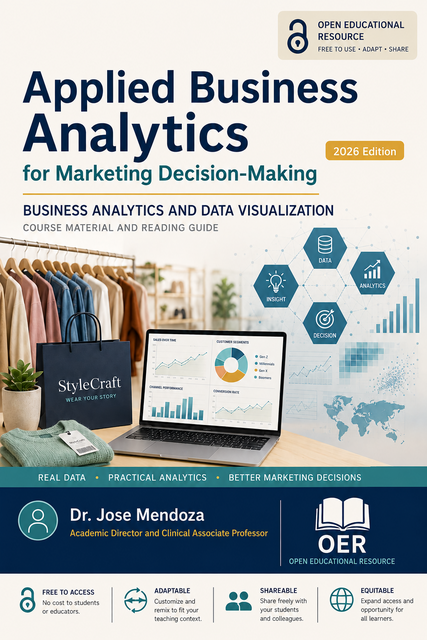
APPLIED BUSINESS ANALYTICS FOR MARKETING DECISION-MAKING
Textbook
Applied Business Analytics for Marketing Decision-Making is an applied textbook designed to help students use data, analytical methods, and visualization to support marketing and business decisions. Written for graduate students in marketing, integrated marketing, business analytics, and related professional programs, the book assumes limited prior experience with programming or statistics and emphasizes conceptual understanding, practical application, and managerial interpretation.
The textbook guides readers through the complete analytics workflow, including problem framing, measurement, data preparation, exploratory and descriptive analysis, customer segmentation, regression, predictive modeling, classification, forecasting, experimentation, data visualization, and the communication of evidence-based recommendations. Students use Python in Google Colab and Tableau to analyze realistic marketing datasets, evaluate analytical outputs, and translate findings into actionable business insights.
A distinctive feature of the book is its treatment of artificial intelligence as part of contemporary analytics practice. Students learn to use AI assistants to generate and troubleshoot code, explore analytical approaches, and improve communication while remaining responsible for verifying results, explaining methods, documenting AI use, and exercising professional judgment. The book’s recurring workflow—specify, predict and verify, explain, and document—reinforces analytical accountability throughout.
Each chapter functions as a self-contained learning unit and includes a marketing decision context, clearly explained concepts, worked examples, hands-on applications, verification checks, ethical considerations, exercises, a glossary, and further readings. As an open educational resource, the textbook is freely accessible and supported by companion datasets, notebooks, templates, and instructional materials.
The resources accompanying Applied Business Analytics for Marketing Decision-Making are designed to support hands-on analysis, classroom instruction, and flexible access to the textbook.
StyleCraft Dataset
The StyleCraft dataset is the primary instructional dataset used throughout the textbook. StyleCraft is a fictional apparel retailer created specifically for this project. Its customer, transaction, product, store, campaign, experimentation, and marketing-performance data support the applied exercises in data preparation, descriptive analytics, segmentation, regression, predictive modeling, classification, forecasting, experimentation, and data visualization.
The dataset is designed to provide a consistent business context across chapters while allowing readers to work with realistic marketing questions. Some files include intentionally introduced data-quality issues or known analytical patterns so that readers can practice verification, compare results, and evaluate whether their analyses recover the expected findings.
Readers should use the dataset alongside the instructions in each chapter. File names, variables, and units of analysis may differ by exercise, so users should review the accompanying data dictionary and chapter-specific guidance before beginning an analysis.
Chapter PDFs
PDF versions of the textbook chapters are provided for readers who prefer to download, print, annotate, or read the material offline. The PDFs preserve the chapter structure, figures, tables, exercises, references, and instructional callouts included in the Manifold edition.
The Manifold version should be treated as the primary and most current edition of the textbook. PDF files represent the version available on the date shown in each document and may not immediately reflect subsequent corrections or minor updates made to the online text.
When citing the textbook, readers should cite the complete Manifold edition or the specific chapter used. Because pagination may differ across formats and versions, section, table, figure, and chapter numbers are preferred when identifying a specific passage.
Use and Attribution
Except where otherwise noted, original textbook content and the StyleCraft instructional dataset are provided under the Creative Commons Attribution 4.0 International License. Users may copy, share, adapt, and build upon these materials with appropriate attribution.
Third-party materials, software, trademarks, and separately licensed resources remain subject to their respective rights and license terms. Users should review any item-specific notices before redistributing or adapting individual resources.
The CC BY 4.0 license applies to the original textbook narrative, author-created exercises, original tables, original figures, instructional activities, and other material created by Jose Mendoza, unless a different notice appears with the material. The license does not automatically apply to material owned by third parties. Third-party photographs, illustrations, screenshots, excerpts, trademarks, logos, datasets, or other materials retain their original copyright or licensing status and must be reused according to the notice accompanying each item.
rights
Applied Business Analytics for Marketing Decision-Making: Business Analytics and Data Visualization*
Except where otherwise noted, this textbook is licensed under the Creative Commons Attribution 4.0 International License (CC BY 4.0).
Citation
Mendoza, J. (2026). Applied business analytics for marketing decision-making: Business analytics and data visualization (2026 ed.) [Open textbook]. Manifold